So, to celebrate the TPK-related end of the first (shortish) Zu campaign, here's the map AND the key to the Iron Courts, the place where the party has met its demise. Appropriately to the name, this complex of rooms and corridors is made entirely of metal - in most places the walls, floor and ceiling are a single slab of smooth, grey metal with rust-coloured stains and streaks; in others, it's metal plating (or more solid metal) of a different type.
(Click to enlarge.)
And the key as a Google document (right-click and select Open in New Window - doesn't seem to work otherwise for some reason.)
The reader might notice an extreme lack of treasure here - that's by design. This sublevel is sort of a "punishment level" where certain wizards have the ability to banish their enemies; as such, the greatest accomplishment one can reasonably expect here is to escape through the large cave at #50.
And just for posterity:
- Hokiman (shaman): despair drove him into passive-agressive behaviour and started deliberately grabbing at the urns in room 42.
- Vestiron (sorcerer): Got too greedy and irresponsible for his own good. Ran out of Hit and Ability Points before figuring out how to remove the urns in room 42 safely.
- Cassandra (Lowlander ranger), Crowley (sorcerer), Sizzy (female beastman): Slowly worn down and killed by two Rust Guardians on top of the battlements at 52. The fight lasted over a dozen rounds, but it didn't occur to them to run. To their credit, they took one of the two enemies down.
Showing posts with label Zu. Show all posts
Tuesday, November 08, 2011
T P K
A long time with no posts, but for a reason. The last fully completed Zu adventures (well, "completed" to a certain value of the word) was reused this past weekend at a local convention, so I didn't want to put up any spoilers about it, but a writeup will be coming along soon. Then, this Sunday... well, I refer you to the title. The party has perished horrendously in the Iron Courts, a sublevel of the Labyrinth they were teleported into by an enemy spellcaster.
For the time being, this also means an end to the Zu campaign - though probably not for good. The party is keen to try out something else as well, so I'll be running them through a one-off Mutant Future adventure then we move on to a brand new setting (and probably brand new set of houserules) of my own: the Buck-Rogers-meets-Dune space fantasy shenanigans of Starlords. And that means a whole new slew of material to post here.
Tuesday, September 27, 2011
Towards a bestiary of Zu
As a note, HD notation sometimes follows Melan's Sword and Magic system. Therefore, HD: 5+2 does NOT mean that you add 2 to the HP total, but that all of the creature's abilities are assumed to have a +2 bonus: +2 to STR, +2 to CON (and therefore to every single Hit Die), etc.. When used, this bonus is already factored into attack rolls, damage and the like.
Animal, phantom
A phantom animal is a pale glowing creature in the shape of one of many normal animals such as crows, deer, dinosaurs, horses or wolves. They may be encountered alone or in groups. The touch of most phantom animals does direct damage to a specific physical ability score, but some may have a ranged attack such as a howl or simply its glow (1 in 6), and / or might affect Intelligence or Wisdom if the victim fails a saving throw (1 in 6). The damage done is a fixed value between 1, 1d2, 1d3 or 1d4 points, depending on the strength of the phantom’s luminousity.
Batrakheios Megas
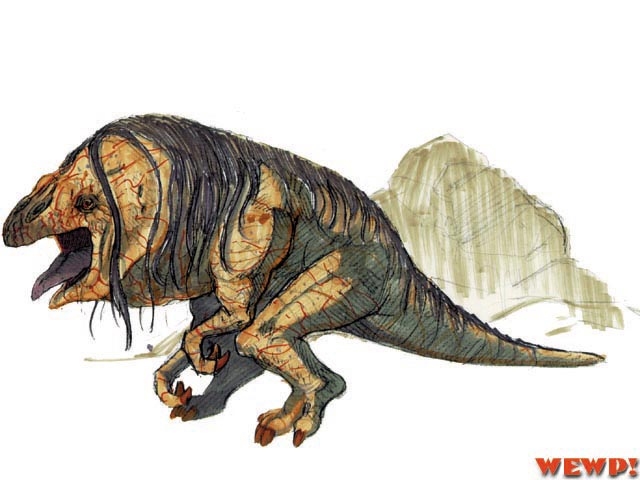
These humongous, vaguely toadlike behemoths may slumber for millenia under the earth’s crust or in the depths of dungeons. At a -5 penalty they may try to grab a victim and swallow him whole, their digestive juices automatically causing 1d6 points of damage per round. Once per day they can let out a tremendous roar that causes 4d6 points of damage and cracks rock. Touching their poisonous skin causes the loss of 2d6 points of CON unless a save is made with a -4 penalty.
HD: 8+2, AC: 12, DR: -4, attacks: 2* +10 paws 1d6+3 HP plus poison, 1* +10 bite 2d6+6 HP
Behemoth
For a detailed description, see previous post. Note that various regional varieties exist that have adapted to their environments: desert Behemoths have sandy/grey skin and scale, swamp Behemoths are green and can hide underwater, volcanic Behemoths are sooty black, impervious to heat, have metallic fur and can sling gobs of lava, etc..
Bicephalous snake
50-50% chance of the heads being on the opposing end, or branching off on the same side.
HD: 2+1, AC: 14, attacks: 2* +3 bite 1d6-1 HP plus poison, 1d6 CON
Bull, divine
Ordinary cattle is virtually (or perhaps completely) unknown on Zu, but Divine Bulls can be occasionally encountered. These creatures often display human intelligence, can be of various majestic colours, and often have various magical powers. The immortal deity kings of the lands strictly prohibit the slaying of bulls, even though they are sometimes aggressive and greatly harmful.
Cuckoo
For these nasty little birds, see the previous game session writeups.
They’re all 1 HD except for a few exceptional individuals. Half-fledged ones have AC 10 and get no attack bonus, fully fledged adults are AC 12 and get +1 to attack.
Flame Turtle
When attacked, this oversized turtle spends an entire round drawing its head and limbs inside its shell, then releases a blast of fire and high pressure air through its gaps. The turtle itself is unharmed by this. The shell is completely impervious to any form of non-magical destruction known to man. Rare variants might release a blast of freezing air, berserker gas, acid spray or other compounds.
HD: 1, AC: 10 when exposed, 18 when withdrawn, attacks: fiery blast 1/3 rounds, 4d6
Glory Snail
These giant snails roam the gently rolling hills and grassy plains. Named after their beautiful appearance, their skin glitters with sparkling slime, and their hard transparent shells let through rainbow-coloured swirls of light from within. Glory Snails emit strong pheromones. From a 100 feet away, this will cause people and animals to feel a sense of euphoria and a desire to sit down and rest, unless they make a saving throw sv. poison at +4. At 20 feet, they must make another save with no bonus or will lose control of themselves and attempt to climb the snail and crawl into its shell.
Once the snail has trapped enough creatures this way, its colourful lights will fade away while it digests for several days, the decomposing remains of the victims visible through the shell.
When attacked, it will defend itself by shooting its oversized love darts (no, really, look up the reproduction of garden snails) which cause 1d6 points of damage and on solid hits (0 HP, damage to ability score) can cause humans to slowly and excruciatingly turn into new Glory Snails over several weeks unless they save.
HD: 5 (1 for purposes of attacking), AC: 10 exposed, 18 when withdrawn, DR -2
Saturday, September 24, 2011
Some spells
These only have provisional levels as they haven't been tested yet.
Calling the Defender of the Brave
Level 2
Summons a spirit of battle to aid a single target. The target will receive +2 to attack, damage, AC and saves when fighting two enemies, and a further +1 per each additional opponent over two, and will be able to make one extra attack per round (but attacks must be made against separate foes). Any action other then a courageous and immediate attack will cancel the spell - this includes flanking maneuvers, tactical withdrawals, or the use of ranged weapons. As a side effect, the target will feel an irresistible urge to laugh in the face of danger and loudly sing warsongs.
Cradle of Giants
Level 3
This spell can only cast in the presence of great amounts of snow or ice - on Zu, this typically limits its use to the high mountains. Upon the completion of the spell, a randomly determined creature will burst out from the snow or ice. If the spell is performed as described in most sources, the creature has a 50% chance of being friendly to the caster; with the addition of certain long-forgotten elements to the ritual, this chance can be increased up to 90%.
1-5 Meh-Teh
6-10 Wind Wolf
11-14 Ice Bear
15-17 Woolly Rhinoceros
18-19 Mammoth
20 Behemoth
Meh-Teh (less commonly also known as Yeti) are large, shaggy humanoids. They have the intelligence and cunning of a particularly bright ape and are skilled at tracking and setting up ambushes in frozen areas. 2 HD, AC 12, att. 1d6+1 (bite and strike)
Wind Wolves are great white or light-grey wolves. Thrice a day they can turn into chilling blasts of wing, crossing great distances at fantastic speeds. They will use this ability to harry prey or escape from danger. 3 HD, AC 14, att. 1d6+1
Ice Bears are mighty and savage white bears. When charging into combat, their snow-white hair becomes a blinding swirl of bright, crystalline sparkles. Those in the immediate vicinity who fail their saves become disoriented for 1d4 rounds, barely able to defend themselves. 3 HD. AC 14, DR 3, att. 1d6+2
Woolly Rhinoceros: 4 HD, AC 14, DR 3, att. 2d6 horn (double on charge) or 3d6 trample
Mammoth: 5HD, AC 14, DR 4, att. 2d6+2 tusks (double if charge) or 4d6 trample
Behemoths are stooped, two-legged mammals creatures that can reach down to a fully grown Tyrannosaurus with their heavy hands and three-foot claws, breaking the reptile's neck with a twist.Their thick, heavy layer of fur and the underlying fat offer better protection against most attacks then the heaviest metal armour. If they manage to grab a human-sized target, they can throw them far in the next round, causing 2d6 points of damage to the victim as well as to whoever was hit by him (requires attack roll). 7 HD, AC 16, DR 5, att. 2* 2d6 grab or 2d6 throw
Three Red Seconds
Level 4
By sacrificing three humans in the evening, the caster summons a horde of lesser demons who build him a sinister red tower on the spot in three seconds. The tower can house up to 50 people in cramped conditions and is an effective defense structure. The sunlight of next morning will cause it to collapse and evaporate within 1 hour after dawn, and astral energy including the casting of any astral spells in the vicinity will cause damage to it (albeit starlight in itself will not be enough to cause significant harm). Increasing the number of sacrifices will increase the area of the tower, incorporating a wall and small outbuildings. A rare version of the spell, shared by the Blood Demons with only a select few, allows the creation of a tower with much greater longevity.
The Ringing of Kurasark’s Bells
Level 5
The spell causes Kurasark’s bells to ring out over a band of heroes (up to 5 people for each level of the caster). The affected become immune to fatigue, fear and any mental effects, and will receive a +1 to attack rolls, saves, AC and current HP. Every time an affected man is slain, the survivors receive a further +1 bonus to the above, up to a maximum of +10. The sound of the bells will inspire all allies and demoralise enemies, and lasts until the next dawn or sunset.
Wednesday, September 21, 2011
On Zu's secrets
For starters, a spell from Zu:
Lesser Empyrean Theft
The caster reaches through a burning pyre to retrieve an amount of unstable Empyrean Flame. Instead of letting it rage freely, the flame can also be wielded as a weapon for one round per level of the spell, causing 2d6 HP damage; or hurled as a single projectile or several smaller ones, for a total 1d6 HP damage per level of the spell. Alternatively, the gate into the Empyrean Realm itself can be shaped and used as a burning barrier by, for example, causing it to stretch across a corridor or cover the floor. A special vessel prepared with materials worth 200 Kon can act as a receptacle for the Empyrean Flame, holding it indefinitely. With a gem-encrusted stylus worth 100 Kon, the flame can be carved into a surface to create Exploding Runes.
Level 1 everburning flame (torch-sized)
Level 2 ball or blade of fire
Level 3 pillar of fire
Level 4 great pyre
Level 5 firestorm
+2 levels use without pyre
Critical success: a friendly (but not enslaved) fire elemental of [spell level] HD is summoned.
Critical failure: the caster is set on fire.
Double critical failure: a hostile fire elemental of 2nd-7th level appears.
Next, some underlying cosmology for Zu which I have to write up eventually anyway, so why not know?
My present and prospective players really, really should not read this.
Names have power. The world of Zu exists and continues to exist because its name gives it the power to do so. In legendary times, a group of heroes arose, carried out acts of legend which will go undiscussed for now, then taken upon themselves to act as stewarts and guardians of the known lands. To this end, they've adopted names which also carry the power of Existence, and rule to this day as the immortal deity-kings already named in an earlier post. Thanks to the power of Existence in their names, their domains continue to harbour human civilisation.
The Lowlands, however, are different. They are an ephemeral land where the landscape twists, disappears and recreates itself constantly, because the power of Existence is not present. Given a king with the right name, it too would settle down like its surrounding areas. Such a king, however, is unlikely to appear, as the Lowlands already have two secret contenders for rulership, and they're unlikely to tolerate a newcomer. Unfortunately, either contender gaining supremacy over the other would certainly make the land even less inhabitable as it is today.
One of the would-be rulers has a well-known name, even if very few people are actually aware of the entity behind it. That name winds through the land as slow and cold water, supporting and taking away life in equal measure. But underneath its namesake river lies the Olm, a titanic creature of blindness and hunger. It has no intelligence in a human sense, but sheer ancestral age has elevated it to a near-divinity that even the greatest sorcerers alive have no hope to match. Should it gain monopoly over the Lowlands, those would turn into a lightless freezing hell of silent, ever-hunting amphibian death.
Opposite the Olm lies another intelligence, as methodical and calculating as the other is instinctive, and just as inhuman. Adventurers know of the Dungeon, the great system of subterranean ruins and caves that allegedly runs beneath the whole stretch of the Lowlands. A few - mainly sorcerers - know that the mysterious entity Baratrón (commemorated in the Baratrón Pact and several other spells) lives at the deepest bottom of the Dungeon. Even fewer believe that Baratrón rules the Dungeon. And a handful might suspect that Baratrón is the Dungeon.
A long time ago, in a distant city state there was a pit into which criminals were thrown. Many died from the fall, but others lived on for hours or even days, broken of body and blinded by pain. They would curse the pit, the city, the people, the gods and all of existence, their souls finally departing them in a black and bitter cloud that would coalesce at the bottom of the pit and coat it with pain, spite and despair. One day, a small crack opened at the bottom of the pit, and started growing and growing over the years. It became a crevice, then a tiny chamber, a cave, a cavern - and eons later, there was the Dungeon, born of the execution pit of a forgotten city. It hates, it schemes, it lures in wizards with pacts and heroes with treasure, and it dreams of a time when the whole world will be a labyrinth of monsters, deadly traps and unloving corridors.
And while the Olm hungers and Baratrón schemes, wild heroes roam the surface. They strive against nature, beasts and each other. They love, hate and dream their heroic dreams that are dwarved by the two secret contenders' power, but which at the same time also tower above those. They are Men, and - for now, at least - the world is theirs.
Saturday, September 10, 2011
Of the Piscine Dimension
Haven't posted for most of the week, naughty me. Hope this makes up for it:
Sustaining Infinity of the Piscine Dimension
Level: 2 (1 with access to plenty of water)
The spell conjures up a head-sized ball of water that can float in one place or rest on a surface at the caster’s wish, and which can be carried in hand if held gingerly. There are 7 fish inside the ball which can be removed one by one and which provide a random effect when swallowed whole:
1-10 Sustenance for an entire day, eater regains 1d6 HP. Can't eat another one until next day.
11-13 Heals 1d6 points of attribute damage or 2d6 HP.
14 Save or magical sleep for 2d6 hours, cannot be awakened. Dreams and visions give (possibly cryptic) answer to one question. If save successful, drowsiness for 1 hour, -1 to all rolls.
15 Ability to speak to aquatic creatures for a day.
16 Hair- and featherless beings become friendly to character, beings with hair or feathers become hostile.
17 Save or go blind. If successful, see in darkness for a day.
18 Racked by pain, cannot attack, defend, walk, or perform any action for a day. Save or lose 1 point from random Attribute.
19 Immune to all (harm- or helpful) effects caused by the waters of the Piscine Dimension.
20 Poison, save at -4 or die. Even with a successful save the victim falls in a coma which can only be cured by water from the Piscine Dimension.
Once all fish are gone, the ball disperses.
Critical failure but confirmation roll succeeds: all fish have negative effects:
1 insatiable hunger
2 stomach cramps: -1d6 HP
3 muteness (1 day)
4 blindness (1 day)
5 scaly skin (-2 CHA, armour chafes, 1 day)
6 can only breath water (1 day)
7 crippling pain (1 day)
8 poison
Lightless Infinity of the Piscine Dimension
Level: 3
The spell turns a pool or well into a gateway to the Piscine Dimension. Anyone jumping into the waters will be picked up by a random current, affected by its magic unless he saves, and delivered to a distant location attuned to that current. Those secured together by a rope or holding hands and succeeding at a STR save will be delivered to the same place. If the receptacle for the spell is prepared in advance with materials at least 1 Bizants' worth, the magical effects of the waters will be negated.
| Name of current | Location | Effect | |
| 1 | Water of the True Olm River | Lair of Olm Astral | +1 WIS, -1 INT permanently; the character might be accepted by the Olmsfolk as a prophet |
| 2 | Draft of the Unlit Channel | The Unlit Channel, in the Dungeon, near the Mask Hall of Barathrón Asterghys | Save or flee in fear from all enemies for a day; 5% chance of automatically detecting moving stonework and hidden passages for a year (needs to concentrate to activate ability) |
| 3 | Zyzlex Bile | The Fungusphere | Poison: -(1d6-1) from random ability, -1d6 HP; 5% chance of poison immunity for a year |
| 4 | Arkanoxon | Pool of Blinding Radiance, on the Shining Plain | +1 INT, +1 CHA, 4 in 6 chance of blindness, 5% chance of +2 to spellcasting rolls and magic saves for a year |
| 5 | Derelict Waters | Palace of the Pale Prince | Abject sorrow for a day: -2 to all rolls except damage |
| 6 | Nihix | Somewhere in the Frozen Hell | -2d6 HP from the cold; 5% chance of fire immunity for a year |
| 7 | Trail of Stars | Heavenly Waters | +1 WIS, +1 CHA; 25% chance of receiving the Mark of Horrors |
| 8 | Fasthold Current | Darkness of Bars and Chains | |
| 9 | Yagrachan | Lake of Dust, in the heart of the Grey Khanate | unquenchable thirst for 3 days |
| 10 | The Undercurrent | Hunter's Abyss | |
| 11 | Seeper Through the Bright Crack | Other Side of the Mirror (roll again to see where exactly on the Other Side | |
| 12 | Current of Blue Water | Heart of the Piscine Dimension | Roll a WIS save: Fail - turn into an aquatic creature Succeed by 5 or less – turn into an elemental creature of water while retain your identity Suceed by 6+ - gain +1 WIS, permanently able to breathe, speak and fully operate in water, speak with intelligent aquatic creatures |
Grand Malediction
Level: 5
The sorcerer utters a curse upon a single victim, prescribing either an ongoing state (such as blindness, wasting disease or poverty), or a singular event (death of all sons, loss of family heirloom etc.). The sorcerer does NOT get to dictate when this state should set in or this event occur, only what is to happen.
In its own time, the curse becomes true. No resistance, no saving throws, nothing. It becomes true.
The uttering of a Grand Malediction is immediately noticed by the Astral Horrors, the Blood Demons and the local god of the land.
Monday, September 05, 2011
Tonight's game
...very quickly. The party continued exploring the Bitter Brambles. They've found a cave they correctly intuited to be the mad hermit's, and placed a Wyvern Watch trap at its entrance. Before doing that, they've check out the inside and found a cave painting with a man holding some ball above his head and birds flying all about. They've moved on, did not investigate a large mound covered in beautiful pastel-coloured roses and swarms of flying, crystalline butterflies. Two of them went in search of a lake they've seen from a distance and found a thick tail hanging out from a thick patch of undergrowth. On a lark they've decided to cut it off, angering a sleeping Ankylosaurus! They've run, avoiding a potentially lethal fight and something interesting.
They've eventually come upon a set of old ruins, similar in style to the village of Stepstone Ford. Combing the ruins, they've found a passageway to an underground complex they've decided to briefly investigate before resting in what seemed like a storeroom. The next day they'ev explored further, finding a pillar with a handprint that activated some lights and caused a hum, strange crystalline eyes peeking out of an unnaturally smooth wall, had the Pnakognomatic Artisan damage some strange, magical metallic roots behind the wall, walked down a corridor several miles long, found an underground hall with a broken crystal dome ceiling to the sky where two Zak Smith Hook Horrors dropped on the Khantúnian. (Can't be arsed to find the specific link on his blog, it's the Monster Manual II redrawing stuff earlier on.) Oh, there was also a nighttime meeting with aforementioned Ankylosaur, too, and some random encounters.
Eventually they went back to the hermit's cave and found the emaciated, wild-haired guy still knocked out by the spirit wyvern after he tried to go home... sometime earlier. They've tied him up, found a rusty knife and a big black rock on him, and marched him back to the village where they were met with great amazement. More later.
Quite a while ago there was an old-school RPG blogger who suggested that no old-school RPG blog entry should go without some new material. For a while, several blogs were, indeed doing that, but I think they've all stopped and forgot that by now. The Headless Horse Archer is here to pick up the slack:
Borgnjor's Revivification
2nd level
This powerful healing spell rapidly heals all wounds, purges poisons and diseases from the body, kills parasites and even regrows lost limbs, eyes or other body parts. However, such a profound effect needs a lot of power to fuel it, and that certainly doesn't come from the magical reserves associated with mere 2nd level magic. Where it comes from is the patient himself, a small part of whose lifeforce is permanently burned up to feed the rejuvenating transformation, causing him to permanently lose 1 point from a random ability.
Yes, it's stolen from Linley's Dungeon Crawl.
They've eventually come upon a set of old ruins, similar in style to the village of Stepstone Ford. Combing the ruins, they've found a passageway to an underground complex they've decided to briefly investigate before resting in what seemed like a storeroom. The next day they'ev explored further, finding a pillar with a handprint that activated some lights and caused a hum, strange crystalline eyes peeking out of an unnaturally smooth wall, had the Pnakognomatic Artisan damage some strange, magical metallic roots behind the wall, walked down a corridor several miles long, found an underground hall with a broken crystal dome ceiling to the sky where two Zak Smith Hook Horrors dropped on the Khantúnian. (Can't be arsed to find the specific link on his blog, it's the Monster Manual II redrawing stuff earlier on.) Oh, there was also a nighttime meeting with aforementioned Ankylosaur, too, and some random encounters.
Eventually they went back to the hermit's cave and found the emaciated, wild-haired guy still knocked out by the spirit wyvern after he tried to go home... sometime earlier. They've tied him up, found a rusty knife and a big black rock on him, and marched him back to the village where they were met with great amazement. More later.
Quite a while ago there was an old-school RPG blogger who suggested that no old-school RPG blog entry should go without some new material. For a while, several blogs were, indeed doing that, but I think they've all stopped and forgot that by now. The Headless Horse Archer is here to pick up the slack:
Borgnjor's Revivification
2nd level
This powerful healing spell rapidly heals all wounds, purges poisons and diseases from the body, kills parasites and even regrows lost limbs, eyes or other body parts. However, such a profound effect needs a lot of power to fuel it, and that certainly doesn't come from the magical reserves associated with mere 2nd level magic. Where it comes from is the patient himself, a small part of whose lifeforce is permanently burned up to feed the rejuvenating transformation, causing him to permanently lose 1 point from a random ability.
Yes, it's stolen from Linley's Dungeon Crawl.
Sunday, September 04, 2011
Equipment for Zu
Last week I totally forgot to print out the equipment list before game. That makes it a suitable topic for my next post, amended with few small bits of explanation:
Coinage:
Local coinage exists in great variety and will be adjudicated on a "spirit of the moment"-base. Khantún has lacquered coins of rare wood with a hole carved through the middle, the barbarians of the Hāāā Plains might occasionally use the pretties and most colourful dinosaur feathers, etc.. The "universal" coinage, or "The Basic Alchemical Catalysts" as known by a few well-informed sorcerers, are the following:
- The Ist. The Ist is a reddish coin of varying hue, roughly round and the size of a large thumbnail, though there's quite a bit of variation. Good for ordinary low-cost items like rope, torch, etc..
- The Kon. A largish coin of shiny dark green metal with complex non-figurative engravings in it. Comes in a variety of shapes from square through round to elliptic, but always the same weight. Worth 10 Ist, and typical adventuring gear (weapons, armour and the like) are measured in the Kon.
- The Bizant. Even larger, shiny and dark blue, more of a medallion than a coin. Very rare, worth a 100 Kon.
These coins are the remnants of a long-forgotten age and nobody knows how to mint more. Occasionally, one might come across what wizards call an "activated" coin. An activated coin always has some magical quality. This can be obvious (glows, feels unnaturally cold or warm, floats on water (though weighting normal), or delivers a small shock on touch); or more elusive (keeps on spinning and spinning once spun, makes a small humming noise when held to the ear, or reacts specially to specific substances). Such coins are usually worth 100 or more times their nominal value to the right buyer - if they're recognised for what they are.
Weapons
Armour & shields*
Equipment & supplies
Beasts******
Special
* So, yeah, armour doesn't improve your AC, but instead decreases the amount of damage you take from attacks. Feel free to rage if you're a true grognard. It works, because:
- Shields and helmets still improve AC, and DEX bonuses are easier to get, so characters will still have a decent AC, only it won't go into the 20-s (or negatives for descending AC).
- Humans can naturally improve only to the fifth level of experience, and monsters are also scaled accordingly (though they can exceed that limit), so the enemy will never have such huge attack bonuses. Or much HP.
- Since melee attacks are roughly in the d6 ball park, medium armour offers a rather decent protection, but still doesn't turn you into an armoured Superman. Heavy armour might, but that's very rare Rosenwalder stuff and good luck getting some. That +1 for two-handed weapons or the STR bonus makes a real difference against medium, though.
- The theme here is that armour was made to be protective against other humans, but if you get attacked by some eldritch monster whose damage code is [multiple] d [whatever], then you're quickly in real trouble. As you should be, since they're eldritch monsters.
- Criticals take off points not from you HP, but from your ability scores (with a *2 modifier to damage code). Which is cool because it's like Traveller, and because it actually adheres to the age-old silly explanation that "HP is not wounds, it's stamina/luck/rolling with blows". It makes perfect sense that if HP is not wounds, then something else must be wounds. Let's take that official explanation which always has been silly, think it through all the way, and we might actually get something that works and even makes sense. More to the point, criticals ignore armour, anyway.
** 1 draught of booze (regardless of type) and a bit of rest after a fight heals you 1d6 HP once per day. I'm pretty sure it worked for Conan, so it works for my players, too. Plus, see above: HP is not wounds.
*** Has anyone ever bought any other type of lantern then "bullseye"? I've never seen it happen. And if everyone always buys just one type, why have several on the list? Anyway, this lantern here is neither. It doesn't do fancy stuff like narrow beams or quick hiding option. And, unlike all D&D lanterns I've ever seen, if you try to turn it 90° so it shines directly up or down a shaft, all the oil pours out and down your neck.
**** These heal 1d6 points of lost ability.
***** One of my favourite dead horses. Lamp oil isn't a damn Molotov cocktail!!!! So here's a separate item, a sort of Alchemist's Fire.
****** Guess these need some explanation, which also educates you about the world of Zu
Riding Lizard - Bipedal, about as tall as an Icelandic pony, carries one rider. The most common riding animal of Zu. Looks a bit like this, minus the hair and with less developed forelimbs. Upsides: it can keep going without rest for a long while, and it's inherently docile and obedient. Downsides: none too bright, obedience means it listens to everyone, not just its owner, not good at running, gets scared and uncontrollable in a fight.
Sandcrawler Lizard - These are like sand-coloured, oversized Komodo dragons which have been stretched a bit. They're very good at moving speedily over sandy terrain, and are primarily used by the Ankur Empire. Each lizard can have two men ride on it in a squatting position (too low to hang your legs down), but their undulating movement might cause seasickness in unaccustomed people - or it might just cause them to fall off. They're very calm, and Ankur janissaries can fire some of their smaller spirit house weapons from the back of a Sandcrawler on the move.
Horse - As mentioned, most civilized people of Zu consider these to be sinister, unnatural, possibly demonic creatures and would want to have nothing with them. Objectively, they're smarter then the usual Riding Lizard, their galloping speed makes them great for pursuit or getaway, and when properly trained, they make formidable platforms to fight from. At the same time, they can't cover the same distances as most reptiles without rest, and training them is a hard art to master.
Hunting Raptor - Size. Appearance. Questions?
Obviously, they're meant to hunt small prey, but can cope with deer-sized creatures when in a pack. They're rather smart and easily trainable, and the noblemen of Ankur and Khantún often breed them as pets - these varieties have incomparable prettier (or more garish) plumage, and would be proportionately more expensive (if at all for sale).
War Raptor - These are your Jurassic Park Raptors (only with feathers, obviously). They can't be ridden, but you can set them loose on the enemy right before a battle for a bit of bloodshed. Of course, the enemy might have some prepared wizards or just some female War Raptors in heat, and then there's no telling which side the bloodshed will be on.
Winged Snakes - These were inspired by Scott Wylie Roberts' excellent Travellers of the Wasteland, which you should check out.
Coinage:
Local coinage exists in great variety and will be adjudicated on a "spirit of the moment"-base. Khantún has lacquered coins of rare wood with a hole carved through the middle, the barbarians of the Hāāā Plains might occasionally use the pretties and most colourful dinosaur feathers, etc.. The "universal" coinage, or "The Basic Alchemical Catalysts" as known by a few well-informed sorcerers, are the following:
- The Ist. The Ist is a reddish coin of varying hue, roughly round and the size of a large thumbnail, though there's quite a bit of variation. Good for ordinary low-cost items like rope, torch, etc..
- The Kon. A largish coin of shiny dark green metal with complex non-figurative engravings in it. Comes in a variety of shapes from square through round to elliptic, but always the same weight. Worth 10 Ist, and typical adventuring gear (weapons, armour and the like) are measured in the Kon.
- The Bizant. Even larger, shiny and dark blue, more of a medallion than a coin. Very rare, worth a 100 Kon.
These coins are the remnants of a long-forgotten age and nobody knows how to mint more. Occasionally, one might come across what wizards call an "activated" coin. An activated coin always has some magical quality. This can be obvious (glows, feels unnaturally cold or warm, floats on water (though weighting normal), or delivers a small shock on touch); or more elusive (keeps on spinning and spinning once spun, makes a small humming noise when held to the ear, or reacts specially to specific substances). Such coins are usually worth 100 or more times their nominal value to the right buyer - if they're recognised for what they are.
Weapons
| Dagger, whip, club | d6-1 | max. 1K |
| One-handed weapons | d6 | 6K |
| Two-handed weapons | d6+1 | 12K |
| Spear | d6 (+1 two-handed) | 4K |
| Thrown weapons (javelin, throwing axe) | d6-1 (+STR bonus) | 2K |
| Sling | d6-1 (d6 w/ lead shot) | 1K / 2K per dozen lead shot) |
| Bow & arrows | d6 | 10K / 1K per dozen |
| Crossbow & bolts | d6, +2 to hit, ROF 1/2 | 20K / 1K per dozen |
Armour & shields*
| Light (leather, studded leather, exitic hides, linothorax, etc.) | -1HP damage per hit | 5K |
| Medium (partial metal, mail shirt) | -3HP damage per hit | 15K |
| Heavy (full mail, qood laminar, etc.) | -5HP damage per hit | 50K |
| Buckler | +1 AC | 3K |
| Medium | +2 AC | 6K |
| Large | +3 AC, heavy encumbrance | 12K |
| Helmet | +1 AC | 5K |
Equipment & supplies
| Acid, 1 vial | 7K |
| Ale, 1 flagon (4 draughts)** | 1K |
| Brandy, 1 bottle (12 draughts) | 3K |
| Candle | 1I |
| Chain, 10' | 8K |
| Incense, 1 stick or perfume, 1 vial | 1K or more |
| Lantern*** | 2K |
| Medical supplies (bandage, herbs, etc.), 1 dose**** | 1K |
| Mirror, small, silver | 10K |
| Oil, fiery***** | 1K5I |
| Oil, lantern | 5I |
| Pole, 10', wood | 1I |
| Rations, travelling, 1 day | 1I |
| Rope, 50', hemp | 5I |
| Rope, 50', silk | 15K |
| Shovel, pickaxe, crowbar, grappling hook, etc. | 2K (per item) |
| Steel & flint | 1I |
| Torch | 1I |
| Wine, Mead, Berrywine etc. (1 bottle, 8 draughts) | 2K |
Beasts******
| Riding Lizard | (1HD, AC10) | 10K |
| Sandcrawler Lizard | (2HD, AC12) | 20K |
| Horse | (2HD, AC12) | 50K |
| Hunting Raptor | (1HD, AC14, d6-2 bite) | 10K |
| War Raptor | (2HD, AC14, damage reduction -1, d6 bite or +2 leap | 30K |
| Winged Snake, hunting | (1HD, AC16) | 15K |
| Winged Snake, messenger | (1HD, AC16) | 20K |
| Winged Snake, poisonous, trained | (1HD, AC16, d6-1 + poison | 50K |
Special
| Alchemy lab equipment, basic set | 3B |
| Hourglass | 6K |
| Lockpicking tools | 15K |
| Musical instrument, simple | 4K |
| Spyglass | 1B |
* So, yeah, armour doesn't improve your AC, but instead decreases the amount of damage you take from attacks. Feel free to rage if you're a true grognard. It works, because:
- Shields and helmets still improve AC, and DEX bonuses are easier to get, so characters will still have a decent AC, only it won't go into the 20-s (or negatives for descending AC).
- Humans can naturally improve only to the fifth level of experience, and monsters are also scaled accordingly (though they can exceed that limit), so the enemy will never have such huge attack bonuses. Or much HP.
- Since melee attacks are roughly in the d6 ball park, medium armour offers a rather decent protection, but still doesn't turn you into an armoured Superman. Heavy armour might, but that's very rare Rosenwalder stuff and good luck getting some. That +1 for two-handed weapons or the STR bonus makes a real difference against medium, though.
- The theme here is that armour was made to be protective against other humans, but if you get attacked by some eldritch monster whose damage code is [multiple] d [whatever], then you're quickly in real trouble. As you should be, since they're eldritch monsters.
- Criticals take off points not from you HP, but from your ability scores (with a *2 modifier to damage code). Which is cool because it's like Traveller, and because it actually adheres to the age-old silly explanation that "HP is not wounds, it's stamina/luck/rolling with blows". It makes perfect sense that if HP is not wounds, then something else must be wounds. Let's take that official explanation which always has been silly, think it through all the way, and we might actually get something that works and even makes sense. More to the point, criticals ignore armour, anyway.
** 1 draught of booze (regardless of type) and a bit of rest after a fight heals you 1d6 HP once per day. I'm pretty sure it worked for Conan, so it works for my players, too. Plus, see above: HP is not wounds.
*** Has anyone ever bought any other type of lantern then "bullseye"? I've never seen it happen. And if everyone always buys just one type, why have several on the list? Anyway, this lantern here is neither. It doesn't do fancy stuff like narrow beams or quick hiding option. And, unlike all D&D lanterns I've ever seen, if you try to turn it 90° so it shines directly up or down a shaft, all the oil pours out and down your neck.
**** These heal 1d6 points of lost ability.
***** One of my favourite dead horses. Lamp oil isn't a damn Molotov cocktail!!!! So here's a separate item, a sort of Alchemist's Fire.
****** Guess these need some explanation, which also educates you about the world of Zu
Riding Lizard - Bipedal, about as tall as an Icelandic pony, carries one rider. The most common riding animal of Zu. Looks a bit like this, minus the hair and with less developed forelimbs. Upsides: it can keep going without rest for a long while, and it's inherently docile and obedient. Downsides: none too bright, obedience means it listens to everyone, not just its owner, not good at running, gets scared and uncontrollable in a fight.
Sandcrawler Lizard - These are like sand-coloured, oversized Komodo dragons which have been stretched a bit. They're very good at moving speedily over sandy terrain, and are primarily used by the Ankur Empire. Each lizard can have two men ride on it in a squatting position (too low to hang your legs down), but their undulating movement might cause seasickness in unaccustomed people - or it might just cause them to fall off. They're very calm, and Ankur janissaries can fire some of their smaller spirit house weapons from the back of a Sandcrawler on the move.
Horse - As mentioned, most civilized people of Zu consider these to be sinister, unnatural, possibly demonic creatures and would want to have nothing with them. Objectively, they're smarter then the usual Riding Lizard, their galloping speed makes them great for pursuit or getaway, and when properly trained, they make formidable platforms to fight from. At the same time, they can't cover the same distances as most reptiles without rest, and training them is a hard art to master.
Hunting Raptor - Size. Appearance. Questions?
Obviously, they're meant to hunt small prey, but can cope with deer-sized creatures when in a pack. They're rather smart and easily trainable, and the noblemen of Ankur and Khantún often breed them as pets - these varieties have incomparable prettier (or more garish) plumage, and would be proportionately more expensive (if at all for sale).
War Raptor - These are your Jurassic Park Raptors (only with feathers, obviously). They can't be ridden, but you can set them loose on the enemy right before a battle for a bit of bloodshed. Of course, the enemy might have some prepared wizards or just some female War Raptors in heat, and then there's no telling which side the bloodshed will be on.
Winged Snakes - These were inspired by Scott Wylie Roberts' excellent Travellers of the Wasteland, which you should check out.
Friday, August 19, 2011
Character creation rules for Zu
And now we get to some crunch. When creating a PC for Zu, first you decide your class: Fighting Man, Adventurer, Wizard or one of several Non-human options.
Fighting Men can use all weapons (with a few rare exceptions) and armour. A Fighting Man character can choose to belong to a particular subtype and receive its bonuses (and penalties). Those who choose not to do so get to roll their new Hit Points twice and take the better result when gaining a level.
A Wizard character can wear no armour, and is restricted to the use of daggers, staves, whips & scourges, and one freely chosen one-handed weapon type. They start the game with 3 random spells. At the DM's discretion, he can choose how many of these should be 1st, 2nd or variable level spells. A Wizard who chooses no subtype is called a Sorcerer and gains a +1 bonus to his spellcasting rolls.
Still in the works:
Demonologist (though it might be just a Sorcerer with a specific spell loadout).
Nonhumans will be done later.
Fighting Man
| Level | Attack bonus | Saving throw | AC (unarmoured) | HD |
| 1 | 1 | 16 | 11 | 1d6+2+CON bonus per level |
| 2 | 2 | 14 | 12 | |
| 3 | 3 | 12 | 13 | |
| 4 | 4 | 10 | 14 | |
| 5 | 5 | 8 | 15 |
Fighting Men can use all weapons (with a few rare exceptions) and armour. A Fighting Man character can choose to belong to a particular subtype and receive its bonuses (and penalties). Those who choose not to do so get to roll their new Hit Points twice and take the better result when gaining a level.
Lowlander Monster Slayer
Receives a +1 to his attack rolls when attacking a monster. At third or higher level, the bonus extends to damage rolls as well; at fifth level, both bonuses increase to +2.Ankuran Janissary
Starts the game knowing the prayers and rituals necessary to operate the blessed weapons of the Empire. Starts with a small and simple Spirit House (small hand cannon) and enough ritual components for 6 uses OR with 2 single-use, pre-blessed Spirit Houses.
Rayyashid Mamluk
Receives +2 to his saving throw for horseriding-related rolls, and a +1 to attack rolls when fighting from horseback. This increase to +4 and +2 respectively at third level.
Khantúnian Bushi
Can concentrate his Chi once per day (twice at third, thrice at fifth level). Receives a +4 to attack rolls and saving throws, and +2 to AC and close combat damage for one round.
Hāāā Plains Barbarian
Receives +1 Hit Point per level. Gains the ability to attack twice per round at third, and three times per round at fifth level. Receives +2 to AC. On the downside, he cannot wear any armour (helmets and shields are allowed); his extreme superstition causes him to suffer a -4 penalty to saving throws against any form of magic; and he must make a save (as against magic) when consciouly trying to tell a lie - if he fails, his inherent primitive honesty forces him to speak the truth.
Rotwalder Volkschmitt
Besides being a competent warrior, he is also a trained smith. Given the necessary tools (which such characters typically start the game with), he can quickly repair splintered shields & helmets by making a saving throw. Other repairs and similar blacksmithing activities typically require more time and better equipment than what can be assumed during an adventure.
Adventurer
| Level | Attack bonus | Saving throw | AC (unarmoured) | HD |
| 1 | 0 | 14 | 10 | 1d6+1+CON bonus per level |
| 2 | 1 | 12 | 11 | |
| 3 | 2 | 10 | 11 | |
| 4 | 2 | 8 | 12 | |
| 5 | 3 | 6 | 13 |
Adventurers live by their skills and wit rather than their combat prowess. As such, they can wield any one-handed weapon and wear light or medium armour. When attempting actions appropriate to their class orientation (such would include climbing, sneaking, acts of legerdemain or appraising the value of treasure), they receive a +1 to their saving throw. If an Adventurer character picks no subtype, he receives a +1 to either his attack bonus or AC.
Lowlander Ranger
Receives a +2 bonus to his saving throw when using it for navigation, pathfinding, tracking or sneaking/hiding in the wilderness.
Urban Thief
Receives and extra +1 to saving throw when attempting any sort of urban skulduggery (such as picking pocket, losing a tail in a crowd, running and jumping from rooftop to rooftop or bribing a guard). He can only wear light armour.
Rayyashid Nobleman
He receives a +1 to saving throws when trying to influence people, and starts with the skill of horseriding (but unlike a mamluk, doesn't receive any bonuses to it). Has a very limited illusionist ability, usable once per week if he makes a saving throw modified by his WIS bonus. This is restricted to replicating the effects of mirage: a green line of vegetation on the horizon, light glinting off of nonexistent metal helmets in the distance, a party of travellers falsely appearing to be in the distance, etc. Can only be used in wide open environments such as the desert or the ocean.
Hāāā Plains Reptile Hunter
Receives a +2 to saving throws when handling, riding, training, calming down or otherwise interacting with reptiles. As a downside, loses all special saving throw bonuses that assume a certain level of cultural sophistication (e.g. value appraisal).
Rotwalder Gildesschmitt
Can repair splintered shields and helmets like a Volkschmitt. Starts with the knowledge of random 2 runes and gains another 2 every level. Can wear any type of armour, but receives no bonuses to adventurer's skills.
Wizard
Wizard
| Level | Attack bonus | Saving throw | AC (unarmoured) | HD |
| 1 | 0 | 16 | 10 | 1d6+CON bonus per level |
| 2 | 0 | 14 | 10 | |
| 3 | 0 | 12 | 10 | |
| 4 | 0 | 10 | 10 | |
| 5 | 0 | 8 | 10 |
A Wizard character can wear no armour, and is restricted to the use of daggers, staves, whips & scourges, and one freely chosen one-handed weapon type. They start the game with 3 random spells. At the DM's discretion, he can choose how many of these should be 1st, 2nd or variable level spells. A Wizard who chooses no subtype is called a Sorcerer and gains a +1 bonus to his spellcasting rolls.
Shaman
Shamans only start with one spell and always cast their spells as a first level character. However, they can interact with the normally unseen spirits of the world if they make a successful spellcasting roll with their WIS bonus as a modifier. Such actions count as magic use, and thus have their HP cost.
Typical uses & appropriate difficulty levels:
| See (or hear) nearby spirits | 1 |
| Identify a spirit | half of the spirit's level (rounded down) |
| Talk to a spirit | 1 (or 3 if the spirit is hostile) |
| Attract nearby spirits from the area | 2 (or 3 for particularly reclusive ones |
| Repulse all spirits from immediate vicinity | 3 |
| Give a command to a spirit | 4 |
| Bind a spirit to an object or chase it away | 5 |
Rotwalder Hohesschmitt
A Hohesschmitt starts the game with kowledge of 4 random runes and gains another 3 at every new level. Additionally, he is a fully capable weaponsmith and can wear all types of armour.
Still in the works:
Demonologist (though it might be just a Sorcerer with a specific spell loadout).
Nonhumans will be done later.
Thursday, August 18, 2011
More on Zu
Once we get this brief setting information done, we can move on to discussing some more spells, monsters or Zu character creation houserules. That's what we're all here for, so let's get on with it:
To the west of the Ankur Empire (and roughly to the north of the Lowlands) lies the Asrakan Desert, a wasteland of rock and sand. It's dunes and labyrinthine mesas are a haven for bandits preying on the few trade and supply routes as well as horrid monsters - preying both the routes and the bandits. Travellers are advised to keep to the rocky southern stretches, as the endless sand seas are often plagued by the grey dust storms of the north and the attending raiders of the little-known but terrifying Grey Khanate, a distant and inimical place where, as they say, grey-skinned people live without water or food, ruled by the terrible Zubotai Khan.
In the centre of the Asrakan desert lies the salty, inland Spice Sea, named for the many exotic crops that can be grown on its salty shore. It is a point of violent contention between the Ankur Empire and the Rayyashid Califate, an alliance of semi-nomadic tribes that occupy the oases and waterways of the western half of the desert watched over and ruled by the allegedly immortal Protector of the Way, Calif Zurún al-Rayya ibn Khaldún ibn Sabbah. Rayyashid tribesmen are described by travellers as polite and hospitable, but this does little to improve their reputation: besides the demonic riders of the Grey Khanate, the Caliphate is the only land where the use of the fell and unnatural beasts called "horses" is accepted and even encouraged.
Somewhere to the west of the desert and the Lowlands, hidden behind great mountain ranges, lies the hidden empire of Khantún. Their fine luxury products occasionally make it into the possession of refined collectors, and rogue Bushi Knights of the land sometime travel into the known lands, but little else is known of these strange-hued, slanted-eyed people and their mighty fungal farms in the jungle. Their ruler is the Incomparable Sage of the Amber Heavens, the Emperor of the Lacquered Throne, Zu Long.
To the west of the Ankur Empire (and roughly to the north of the Lowlands) lies the Asrakan Desert, a wasteland of rock and sand. It's dunes and labyrinthine mesas are a haven for bandits preying on the few trade and supply routes as well as horrid monsters - preying both the routes and the bandits. Travellers are advised to keep to the rocky southern stretches, as the endless sand seas are often plagued by the grey dust storms of the north and the attending raiders of the little-known but terrifying Grey Khanate, a distant and inimical place where, as they say, grey-skinned people live without water or food, ruled by the terrible Zubotai Khan.
In the centre of the Asrakan desert lies the salty, inland Spice Sea, named for the many exotic crops that can be grown on its salty shore. It is a point of violent contention between the Ankur Empire and the Rayyashid Califate, an alliance of semi-nomadic tribes that occupy the oases and waterways of the western half of the desert watched over and ruled by the allegedly immortal Protector of the Way, Calif Zurún al-Rayya ibn Khaldún ibn Sabbah. Rayyashid tribesmen are described by travellers as polite and hospitable, but this does little to improve their reputation: besides the demonic riders of the Grey Khanate, the Caliphate is the only land where the use of the fell and unnatural beasts called "horses" is accepted and even encouraged.
Somewhere to the west of the desert and the Lowlands, hidden behind great mountain ranges, lies the hidden empire of Khantún. Their fine luxury products occasionally make it into the possession of refined collectors, and rogue Bushi Knights of the land sometime travel into the known lands, but little else is known of these strange-hued, slanted-eyed people and their mighty fungal farms in the jungle. Their ruler is the Incomparable Sage of the Amber Heavens, the Emperor of the Lacquered Throne, Zu Long.
To the southwest of the Lowlands lie the barbaric Hāāā Plains. The longhaired, loincloth-clad barbarians of the plains have three main occupations: quarreling between tribess; raiding settlements beyond their borders for metal tools and weapons to better quarrel between tribess with; and hunting, trapping and taming the myriad species of dragon-lizards that seasonally migrate here from the south then selling them to the highest bidder as riding mounts, beasts of burden or warbeasts. These people are far too disorganised to have any sort of formal rulership, but a certain barbarian hero called Zungarr the Mightiest commands the grudging respect of all - and in fact has been doing so for centuries, if these barbarians are to be believed.
To the east of the Hāāā Plains lie the forbidding mountain peeks and deep dark valleys of the Rotwald Forest. A traveller must tread carefully and never deviate from the trails that connect the hamlets and villages of the valleys, lest they be lost forever or snatched up by the things lurking beneath the dense canopy. While most travellers only encounter the villages, the real power over the Rotwald Forest is held by the mountain fortresses of the reclusive Smithing Lords. The Smithing Lords are the preeminent weapon- and armoursmithes of all the known realms, creating - and jealously guarding - designs not even imagined anywhere else, and imbuing their best creations with the magic of mysterious runes. For a warrior, the armoury of a single Rotwalder hohesschmitt would be worth more than the Ankuran Imperial treasury - and, fittingly, an attempt at it would be similarly more preposterous. Little is known of the internal organisation of the Gilde, but the high-ranking master smithes are believed to be engaged in constant and covert struggle for each others' most powerful runes and weapons. Nevertheless, an entity called Zugfried Dwimmerschmitt is always spoken of with great deference, regardless the speaker's affiliations.
The last known land, sandwiched between the Rotwald and the Eastern Ocean, is the God Coast. Little is known of this narrow but long strip of land, as most who go there come back thoroughly changed - or not at all. What's known is that the land is peppered by hundreds, if not thousands, of shrines, temples and cathedrals, each consecrated to a different god. Some of these occasionally send missionaries to other lands, but the tenets spread by these people are just too strange to win many people over. Having said that, some of these missionaries do seem to have extraordinary abilities and magics at their command, so maybe not all these religions are the product of fevered delusion, after all.
Sunday, August 14, 2011
A stream-of-consciousness deconstruction of monster creation
Just yesterday I found myself asking: how would I rework the Marilith? For the edification of my readers, here's a complete recording of the thought process:
Well, what is a Marilith? It's a large snake tail with some chassis at the front that holds a hole bunch of arms to fight with - let's go with this basic idea. Snake tail, okay, but let's top it with something scarier then a naked woman with tits (and some extra limbs). What's scary and has a lot of arms? Spiders. So it's a large (I guess maybe small horse-sized) spider with a long, heavy, ponderous snake tail where its abdomen would be.
It won't be waving around scimitars with its hairy spider legs, so let's give it a different method of attack. It bites and poisons, sure, but something else as well. It's half snake, and there's such a thing as a spitting snake, so I'll make it spit... but what? Poison is passe. It should spit something related to snakes or spider... flies! It spits living flies - or more accurately, tiny, vaguely humanoid fly-men. It creates them from the juice sucked out of its victims. The flies don't attack directly. They, ermm... they're flied, they're dirty, they spit on food. They land on food and infect it with the spirit of distrust, intolerance and hatred. They also so small theylook like normal flies at a glance, which works just fine: I want demons to be about more than just hitting hard and being tough to kill. So the spidersnake demon hides in caves, ruins and the like near populated areas and sends forth its tiny minions to spread hatred and chaos via the infected food.
So far, so good, but it needs something more, like some creepy extra body parts. Have you ever seen up-close photos of spiders? Those extra eyes sure look creepy, so I'll work with that. When it feels threatened (say, by adventurers), smaller snakes grow out of its eyes and try to bite its enemies. But here's a great opportunity to add something even more: those smaller snakes (well, normal-sized snakes) also have the forebodies of spiders! They're smaller copies of the entire demon. And since they're copies, they also have a whole bunch of eyes, so you have even smaller growing out of those, and of course they too have a spider body. And eyes. With snakes growing out of them.
As it were, this here is a fractal monsters which has smaller copies of itself growing out of its eyes, and out of the eyes of those, and so on ad infinitum. A single spidersnake is in fact an infinite number of ever-regressing spidersnakesand they all get a separate attack roll f*ck NO. We don't need that, only the first four get that. But we do keep the infinite regression thing, because it's nicely Cthulhoid and as such highly appropriate for a demon. So here's our lovely:
The Deepest Planter of Ebony Seeds*
4 Hit Dice. AC 14. Reduces all physical damage by 3 HP. Bite attack 1d6 HP + save vs. poison or temporarily lose 1d6 points of DEX. 4 additional eye-snake attacks when not surprised, each as a 2HD monster that does 1d6-1 HP. Does the fly-man food infection thing and also sees and hears through them.
*All stats for World of Zu, the numbers would be completely different for standard D&D.
Next time I might make a monster that combines a bear with a stone wall.
Well, what is a Marilith? It's a large snake tail with some chassis at the front that holds a hole bunch of arms to fight with - let's go with this basic idea. Snake tail, okay, but let's top it with something scarier then a naked woman with tits (and some extra limbs). What's scary and has a lot of arms? Spiders. So it's a large (I guess maybe small horse-sized) spider with a long, heavy, ponderous snake tail where its abdomen would be.
It won't be waving around scimitars with its hairy spider legs, so let's give it a different method of attack. It bites and poisons, sure, but something else as well. It's half snake, and there's such a thing as a spitting snake, so I'll make it spit... but what? Poison is passe. It should spit something related to snakes or spider... flies! It spits living flies - or more accurately, tiny, vaguely humanoid fly-men. It creates them from the juice sucked out of its victims. The flies don't attack directly. They, ermm... they're flied, they're dirty, they spit on food. They land on food and infect it with the spirit of distrust, intolerance and hatred. They also so small theylook like normal flies at a glance, which works just fine: I want demons to be about more than just hitting hard and being tough to kill. So the spidersnake demon hides in caves, ruins and the like near populated areas and sends forth its tiny minions to spread hatred and chaos via the infected food.
So far, so good, but it needs something more, like some creepy extra body parts. Have you ever seen up-close photos of spiders? Those extra eyes sure look creepy, so I'll work with that. When it feels threatened (say, by adventurers), smaller snakes grow out of its eyes and try to bite its enemies. But here's a great opportunity to add something even more: those smaller snakes (well, normal-sized snakes) also have the forebodies of spiders! They're smaller copies of the entire demon. And since they're copies, they also have a whole bunch of eyes, so you have even smaller growing out of those, and of course they too have a spider body. And eyes. With snakes growing out of them.
As it were, this here is a fractal monsters which has smaller copies of itself growing out of its eyes, and out of the eyes of those, and so on ad infinitum. A single spidersnake is in fact an infinite number of ever-regressing spidersnakes
The Deepest Planter of Ebony Seeds*
4 Hit Dice. AC 14. Reduces all physical damage by 3 HP. Bite attack 1d6 HP + save vs. poison or temporarily lose 1d6 points of DEX. 4 additional eye-snake attacks when not surprised, each as a 2HD monster that does 1d6-1 HP. Does the fly-man food infection thing and also sees and hears through them.
*All stats for World of Zu, the numbers would be completely different for standard D&D.
Next time I might make a monster that combines a bear with a stone wall.
Saturday, August 13, 2011
The world of Zu
The first of several writeups (the publication of which will probably be interrupted when I get distracted by some other idea) on the World of Zu, a Strange Fantasy setting. "Strange Fantasy" is a phrase I've just invented for a style which is a bit like Weird Fantasy but isn't quite so extreme. Instead of, say, being full of astronauts, cactus men (shout-out to Planet Algol!) and Radium Pistols, it's more Sword & Sorcery with some astronauts and cactus men. (Well, not those specifically, but you get the idea.) I'm not very happy with the phrase; "Queer Fantasy" would have expressed the notion of "weird but not quite so much" a while ago, but of course these days it would mean something altogether different. Dear Reader, if you come up with a better term for the sort of thing I have in mind, post it in the comments and you'll win a prize! Anyway, Zu:
The Lowlands of the Lost lies in the centre of the known lands of the World of Zu. Also known as the Land of River, Road and Rampart, named for its three major landmarks which allow the ragtag population to maintain a semblance of coherence: the Olm River, the Sword Trail and the ruins of the Cephean Rampart.
It's called the Lowlands of the Lost for good reason: almost all known methods of navigation fail here. No one knows what ancient magical or other forces make it so, but the fact remains: trees grow moss on all sides in the forest, magnet stones spin around, the stars and constellations dance around the sky unpredictably, and even the sun always rises at a different point of the horizon. In fact, the very layout of the land itself twists and rearranges itself from time to time: you may follow a path from one point to another and make extensive notes and maps; but if you try to follow the same instructions half a year later, you'll probably end up in the middle of the wilderness, thoroughly confused about how even the mountains and lakes seem to be completely elsewhere.
Nevertheless, people do manage to get from one tiny community to the other, and even some occasional trade exists: some people - always born in the land - seem to have a good if not infallible instinct that keeps them on the true path to wherever they're going. And even if you don't have the services to such a guide, features located close enough to the Olm River, the Sword Trail and the Cephean Rampart seem to be much more 'stable' then other spots, so the routes along these three tend to remain largely unchanged for years on end. Anything beyond, however, whether they be dark and humid forests, trackless swamps or labyrinthine hills and canyons, belongs to the daring, the desperate and the foolhardy who bet their lives against the prospects of finding a new, profitable trading route, an undiscovered mine of precious gems, or a lost city of foreboding and maybe even treasure-laden tombs....
However, not all lands of Zu are as inimical to civilisation as the Lowlands. If one travels to the Sour Coast (named after the peculiar taste of the ocean water here) in the east and then heads north and through one of the many gaps in the mountains girdling the Lowlands, he comes to the southern edge of the flourishing Ankur Empire.
The mightiest force in the East, the Empire is a land of great cities protected by thick walls, tall towers and the divine guidance of the god of the land, the immortal Sultan Zuliman. It was Zuliman who armed his janissary soldiers with the divine weapons of the Empire: these closely guarded artifacts act as houses for elemental spirits of air and fire. By performing the proper incantations and gestures and placing the necessary sacrifices into these receptacles, the spirits will strike the unrighteous with lethal fury.*
More later.
*True. Contrarily to whatever metagaming assumptions players might have, they really only work with the exact prescribed prayers and gestures. If someone tries to cut out the ceremonial stuff and tries to "just load the gun", it will not work. In fact, the spirits might well get offended and "misfire".
The Lowlands of the Lost lies in the centre of the known lands of the World of Zu. Also known as the Land of River, Road and Rampart, named for its three major landmarks which allow the ragtag population to maintain a semblance of coherence: the Olm River, the Sword Trail and the ruins of the Cephean Rampart.
It's called the Lowlands of the Lost for good reason: almost all known methods of navigation fail here. No one knows what ancient magical or other forces make it so, but the fact remains: trees grow moss on all sides in the forest, magnet stones spin around, the stars and constellations dance around the sky unpredictably, and even the sun always rises at a different point of the horizon. In fact, the very layout of the land itself twists and rearranges itself from time to time: you may follow a path from one point to another and make extensive notes and maps; but if you try to follow the same instructions half a year later, you'll probably end up in the middle of the wilderness, thoroughly confused about how even the mountains and lakes seem to be completely elsewhere.
Nevertheless, people do manage to get from one tiny community to the other, and even some occasional trade exists: some people - always born in the land - seem to have a good if not infallible instinct that keeps them on the true path to wherever they're going. And even if you don't have the services to such a guide, features located close enough to the Olm River, the Sword Trail and the Cephean Rampart seem to be much more 'stable' then other spots, so the routes along these three tend to remain largely unchanged for years on end. Anything beyond, however, whether they be dark and humid forests, trackless swamps or labyrinthine hills and canyons, belongs to the daring, the desperate and the foolhardy who bet their lives against the prospects of finding a new, profitable trading route, an undiscovered mine of precious gems, or a lost city of foreboding and maybe even treasure-laden tombs....
However, not all lands of Zu are as inimical to civilisation as the Lowlands. If one travels to the Sour Coast (named after the peculiar taste of the ocean water here) in the east and then heads north and through one of the many gaps in the mountains girdling the Lowlands, he comes to the southern edge of the flourishing Ankur Empire.
The mightiest force in the East, the Empire is a land of great cities protected by thick walls, tall towers and the divine guidance of the god of the land, the immortal Sultan Zuliman. It was Zuliman who armed his janissary soldiers with the divine weapons of the Empire: these closely guarded artifacts act as houses for elemental spirits of air and fire. By performing the proper incantations and gestures and placing the necessary sacrifices into these receptacles, the spirits will strike the unrighteous with lethal fury.*
More later.
*True. Contrarily to whatever metagaming assumptions players might have, they really only work with the exact prescribed prayers and gestures. If someone tries to cut out the ceremonial stuff and tries to "just load the gun", it will not work. In fact, the spirits might well get offended and "misfire".
Friday, August 12, 2011
Pay for one spell, get 10 new monsters for free
Baratrón Pact
Level: 7, -1 for each HD of sacrifice at casting
This spell forms a pact between the caster and the mysterious subterranean entity Baratrón, who provides the former with a randomly determined obedient servant. The creature will follow the caster’s commands to the best of its abilities and serves for an indeterminate period of time. Once the creature is slain, banished from this world or magically removed from under the caster’s control, the caster must offer a second sacrifice of intelligent creatures, this one commensurate with the power of his former servant: a total of 1 HD for each of the creature’s plus the wizard’s HD (so a 4th level wizard who's just lost his Animated Statue must offer a sacrifice worth 7 Hit Dice - since normal humans do not advance to such levels, this means a number of victims). Should he fail to perform this within three days, he will permanently lose 2 points for each HD from random attributes.
- – Subterranean Man
- – Pit Victim
- – Earth Elemental
- – Living Statue
- – Pnakognomatic Artisan
- – Baratrian Smoke Demon
- – Clockwork Horror
- – Troglodyte
- – Eye of Stone
- – Ancient One Who Sleeps
Subterranean Man
A man with white or no hair, pale skin and milky eyes. He is like a normal fighting man (1st to 3rd level), but with the following exceptions:
- He is blind, and therefore immune to blinding effects such as sharp or stroboscopic lights as well as to purely visual illusions.
- His sharp hearing and preternatural senses are functionally equivalent to 90’ of vision in any light conditions.
- Due to Baratrón's blessing, he always understands his master’s commands, but can only speak his own unintelligible language.
- Accustomed to living in caverns: +2 to climbing and swimming rolls, +4 to moving silently in enclosed spaces characterised by hard surfaces.
Subterranean men are normally equipped with a metal club (1d6 damage), a small dagger and two dozen doses of blade poison (1d6-2 HP, -1d8/-1d8 DEX). They will not wear armour.
Pit Victim
A criminal thrown into the punishment pits of ancient and distant cities, reanimated by Baratrón's will. An undead creature with blackened and hardened skin, covered in long dark rags. Understands speech but cannot communicate. It automatically detects hostile intent towards its master and autonomously takes steps to cruelly dispose of the threat unless explicitly ordered otherwise. Either carries an ancient, badly rusted weapon or uses its long, disease-ridden claws.
1-3HD, AC10, dam. 1d6-1 or 1d6-2 + disease: 1d4 STR / 1d4 CON
Earth Elemental
A hulking, shape of rock and earth that can pull itself into a vaguely humaoid appearance. It can tear down walls and dig through rock easily. All worked stone in its vicinity - bricks, walls, flagstone, statues, etc. - will slowly revent into natural stone formations over a matter of months, weeks or days, depending on the elemental's level. When not in contact with stone or earth, or when at least partially submerged in water, it slowly disintegrates, losing 1 HP per round.
3-8 HD, AC18, dam. 1d6 (3-4 HD), 2d6 (5-6 HD) or 3d6 (7-8 HD).
Animated Statue
An exquisitely carved statue of stone, typically depicting a human or animal. Intelligent enough to follow complicated commands, but always remains very literal in their interpretation. When faced with a situations undefined by its instructions, it will try to follow the nearest match in its orders. Unless its master puts some thorough thinking into his instructions, this nearest match might well boil down to "protect me", which in turn might become "kill anything that come close." Animated statues can speak in a resonant voice, but usually only do that when isntructed to do so or when told to report some past event.
3 HD, AC17, dam. 1d6+2. Takes minimum damage from non-blunt weapons.
Pnakognomatic Artisan
In this dimension the creature appears as a hunched, lean, black-skinned, hairless dwarf. While it only has one Hit Die, it counts as a 5HD creature for the purposes of sacrifice as described in the Baratron Pact spell. It cannot wield weapons or wear armour, but has the ability to part and pefectly reseal earth, rock and minerals (the latter only in their natural state) with its comically oversized bare hands. Furthermore, when given the necessary materials, even in their raw state (such as a vein of iron ore instead an ingot), it can manufacture any non-magical metal or stone item in one hour without tools. It can communicate with its master, and anyone else the master declares is privy to such conversation, in a multitonal whisper that everyone perceives as his or her native language.
If the Pnakognomatic Artisan is killed, its full and proper form will momentarily intrude upon our dimension in its death throes. At the end of the round of its death, it will transform into a giant tentacled non-Eucledian monster and randomly lash out at nearby targets, attacking as a 10 HD creature. In this single destructive act it will lash out with 5 tentacles (1d6 damage); bite with its gaping mouth full of pointy teeth at the closest possible target (2d6+2 damage); and shoot a black eyebeam of death energy (save or die). Once the monster is still, it is sucked back into its native dimension, leaving no body behind.
Pnakognomatic Artisan: 1HD, AC11, dam. 1d6-1
Baratrian Smoke Demon
This intelligent, malevolent creature comprises tendrils of poisonous dark smoke and counts as a 4 HD monster for purposes of the Baratron Pact. It can fly and fit through the tiniest crack and is completely immune to non-magical weapons and most spell effects, some notable exceptions being wind, banishment or domination by arcane means. It attacks by engulfing its target: the victim can hold his breath by making a CON save with a cumulative -2 penalty for every round after the first, or try to outrun the smoke by an opposed DEX check (the demon is considered to have DEX 12, horndwarves take a -4, lizardmen a -2 penalty). A failure indicates that the demon’s poisons have penetrated the victim’s lungs, causing 1d6 points of damage to a randomly chosen attribute.
When located outside the Underworld, the Demon needs an unholy container, typically a clay or stone jar, to regularly retreat into and regain composure. If this jar is destroyed, the Smoke Demon will permanently disperse in a few days.
While the Baratrian Smoke Demon is capable of operating above grounds, it will only do so by the explicit command of its master, since it has problems navigating even a light breeze, and a stronger wind is pretty much lethal to it.
1HD, AC: 12 (only against magic weapons)
Clockwork Horror
All cogs, joints, axles, pincers and swirling blades, Clockwork Horrors are mechanical monsters that come in a great variety of sizes and (sometimes vaguely human- or animal-like) shapes. They only take minimum damage from piercing and slashing weapons (except heavy, two-handed swords and axes), and are immune to fire, poison and all other effects that would not affect a steel machine. Electricity causes them to stop amidst convulsions for 1d4 rounds, but after that they’ll be quickened, having twice the movement rate and twice the usual number of attacks for the same duration. The smallest ones with 1 Hit Dice can climb over all but the smoothest surfaces, even upside down, and 2 HD ones also retain some of this ability to a lesser extent.
| Roll | HD | AC | Attacks |
| 1-3 | 1 | 15 | 1d6-1 |
| 4-6 | 2 | 15 | 1d6/1d6-1 |
| 7-9 | 3 | 15 | 1d6/1d6/1d6-1 |
| 10-11 | 4 | 15 | 1d6+1/1d6/1d6/1d6-1 |
| 12 | 5 | 15 | 1d6+1/1d6+1/1d6/1d6/1d6-1 |
Subscribe to:
Posts (Atom)